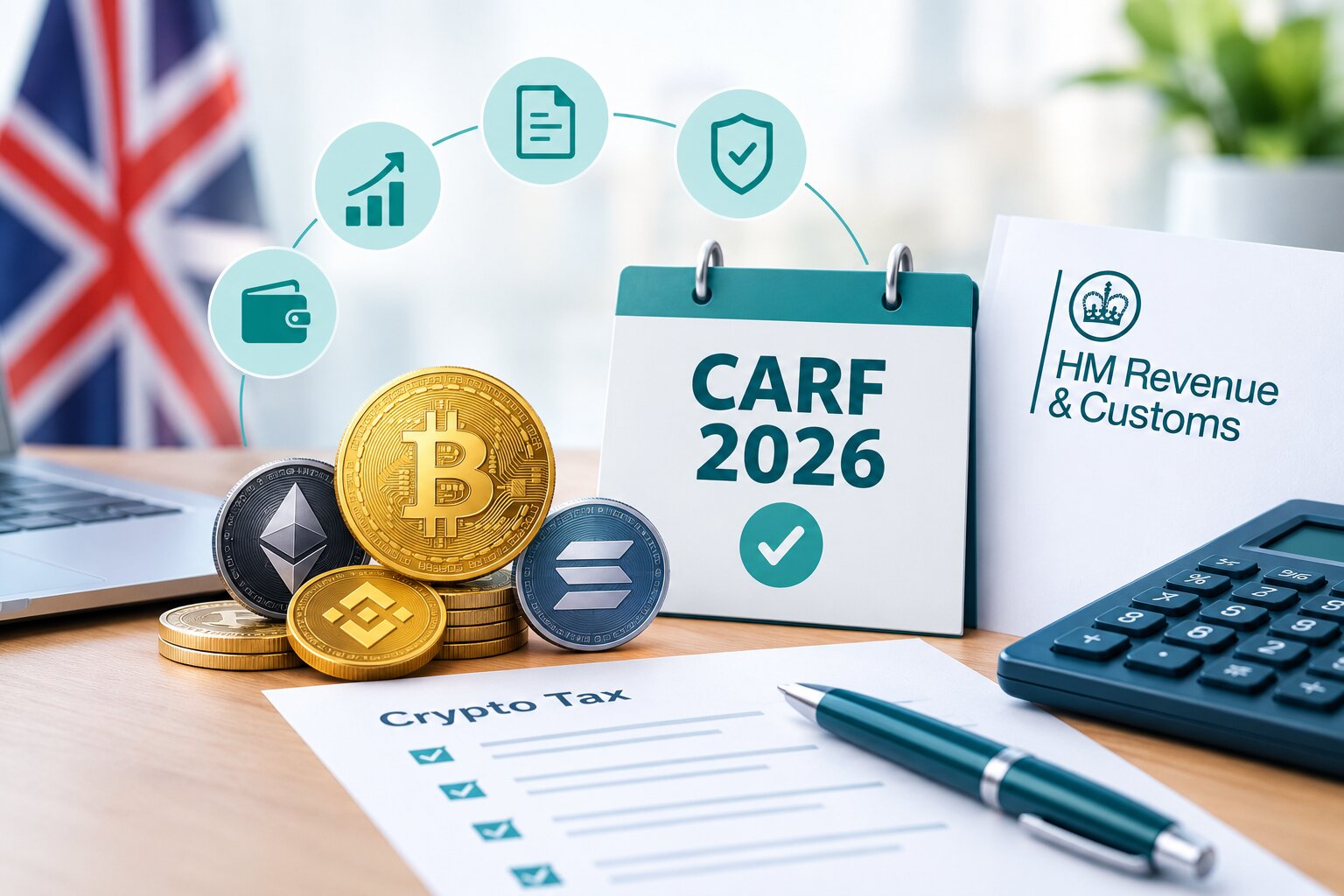
If you’ve bought, sold, swapped or earned any crypto in the last few years, there’s a change you need to know about. From 2026, crypto is no longer a blind spot on HMRC’s radar. With the new Cryptoasset Reporting Framework (CARF), that radar will soon know your name, your address and pretty much every trade you’ve made.
Crypto isn’t niche any more. According to FCA consumer research, UK crypto ownership peaked at 12% of adults in 2024, roughly 7 million people, before dropping to 8% in 2025. However, even at 8%, that’s still double the share of people who owned crypto in 2021, when it stood at 4%. And while fewer people now hold crypto, those who do are holding bigger balances on average (source: FCA).
The problem for HMRC is that plenty of people don’t realise crypto is taxable. HMRC’s answer is CARF, which it estimates will bring in £315 million in previously unpaid tax by April 2030 (source: HMRC).
First, we’ll walk you through what’s happening, what you need to know and what HMRC will know about you. Then we’ll share the four steps our crypto accountants recommend to help you stay on the right side of HMRC, remain compliant and pay the right amount of tax.
1. So what is the Cryptoasset Reporting Framework (CARF)?
The Cryptoasset Reporting Framework (CARF) is a set of international rules that lets tax authorities in different countries share information about your crypto transactions. It was created by the Organisation for Economic Co-operation and Development (OECD), and it works in a similar way to the rules that already let countries share details of your bank and investment accounts, known as the Common Reporting Standard (CRS).
Under CARF, crypto platforms (or, as HMRC calls them, Reporting Cryptoasset Service Providers or RCASPs) will have to collect information about their users and their transactions every year and pass it on to the tax authority. CARF was originally designed to cover people living overseas, but the UK has extended it to UK residents too. This means HMRC will receive data on UK crypto taxpayers from UK platforms, as well as from overseas platforms through international data sharing. (Source: GOV.UK, Domestic reporting of UK resident cryptoasset users under CARF).
2. When does CARF start in the UK? Key dates for 2026 and 2027
1st January 2026: Crypto platforms start collecting your data
31st January 2027: Your last chance to get your historic tax affairs in order.
This is the Self Assessment Tax Return deadline for the 2025/26 tax year. That means it’s also the date by which platforms must register with HMRC’s new online service and tell their users that they’ll be reporting their details (source: GOV.UK). If you’ve got unreported crypto gains or income from previous years, this is the moment to fix them.
31st May 2027: Platforms send your data to HMRC for the first time.
The first report covers 1 January to 31 December 2026, and must reach HMRC by 31 May 2027. Furthermore, from 31 May 2027, HMRC will automatically start receiving data on UK residents from crypto exchanges in 52 jurisdictions, with more joining in 2028.
3. What Will HMRC Know About Me as a Crypto User?
Actually, quite a lot. For individual crypto users, platforms must collect your name, date of birth, and National Insurance number. If you’re not a UK resident, they must collect your taxpayer identification number. For companies, partnerships, trusts, and charities, they’ll collect the legal name, main business address, and company registration number (or the overseas tax ID). For every transaction, they’ll record the type of cryptoasset, the type of transaction, and its value (source: GOV.UK)
HMRC then matches that data to your tax records. Their guidance states they will use this information to link your crypto activity to your crypto tax record so they can check that you’re paying the right amount. If your platform reports thousands of pounds in disposals and your tax return says nothing, that gap will stand out.
Why is my crypto exchange asking for my National Insurance number?
This is because the law now requires platforms to request this data. Your National Insurance number is the exact mechanism HMRC uses to link transactions directly to your tax record. It is vital not to ignore these requests; investors who fail to provide the necessary details can face fines of up to £300, while exchanges can be fined up to £300 per unreported customer.
Why am I getting a crypto “nudge letter” from HMRC?
A nudge letter is HMRC’s way of letting you know that something may be missing from your tax return. It isn’t a formal investigation; it is simply a warning. HMRC is already using the data it receives from exchanges to send these out. If you receive one, don’t panic. Check your records, work out whether you owe anything, and respond, or get in touch with our crypto accountants to get the answers and help you need.
Does HMRC know about my crypto if my exchange is overseas?
Yes, this is the whole objective of CARF. Developed by the OECD, the framework acts as a global safety net that makes it much harder to hide crypto in overseas accounts, with more than 60 countries committed to sharing data.
A second wave of major jurisdictions, including Switzerland, Singapore, Hong Kong and the UAE, will begin automatic reporting in 2028. Using an overseas or offshore exchange is now far less likely to keep your transactions out of HMRC’s view.
4. When do I pay tax on crypto in the UK?
HMRC doesn’t treat crypto as money. But why? Because it lacks legal tender status and central bank backing, categorising it instead as an intangible asset similar to shares. As a result, two main taxes apply: Capital Gains Tax and Income Tax, depending on your specific transactions. This highlights why HMRC’s distinction between Capital Gains Tax and Income Tax matters: did you dispose of the crypto, or did you earn it?
-
Capital Gains Tax: when you dispose of crypto
In the eyes of HMRC, a disposal occurs whenever you part with an asset, regardless of whether it has changed in value since you acquired it. You do not need to convert your crypto back into physical cash to trigger this. Any transaction that transfers ownership is a disposal, regardless of whether the asset has gained value or decreased in value, resulting in a capital loss.
You may owe Capital Gains Tax when you make a disposal by:
– Selling tokens for fiat currency: For example, if you bought 1 ETH for £1,500 and later sold it for £3,000, you have realised a taxable gain of £1,500.
– Exchanging one crypto for another: Swapping Bitcoin for Solana, or even swapping it for a stablecoin like USDT, counts as disposing of your Bitcoin at its current market value.
– Gifting crypto: Giving cryptocurrency to anyone other than your spouse or civil partner is treated as a disposal, and your tax liability is calculated based on the asset’s market value at the time of the gift.
– Using crypto to buy goods or services: Spending your cryptocurrency to pay for a product or service counts as disposing of that crypto, triggering a potential tax on the gains.
-
Income Tax: when you earn crypto
All crypto received as income must be converted and reported in British Pounds (GBP) using the fair market value at the exact time you received it.
– Getting paid in crypto for work: If your employer or client pays you in crypto, it is taxed as income based on its sterling value when received.
– Mining or staking rewards: Say you earn 0.005 BTC from mining on a day when Bitcoin is worth £90,000. That is £450 of income, and staking rewards work the same way.
– Receiving an airdrop: If you performed an action to receive the airdrop—such as using a platform or sharing a post—it is usually taxable as income upon receipt.
– Also: If you later sell, swap, or spend any crypto you earned, that disposal can trigger Capital Gains Tax too, using the value you paid Income Tax on as your starting cost (allowable cost).
5. What is the tax rate on crypto Gains?
For UK Capital Gains Tax, you have an annual tax-free allowance of £3,000. Gains above this are taxed at 18% if they fall within your basic-rate band, and 24% above it. Remember that selling, swapping one crypto for another, spending or gifting crypto all count as disposals. If you’re registered for Self Assessment, you must also report your crypto disposals if the total proceeds exceed £50,000 in a tax year, even if your gains are below the £3,000 allowance (Source: Capital Gains Tax & Allowances by HMRC). As crypto tax rules can be complex, we highly recommend getting in touch with our expert crypto accountants for advice tailored to your situation.
| Amount / Rate | |
|---|---|
| Annual tax-free allowance | £3,000 |
| Gains within the basic-rate band ( Gains where your total income and gains are up to £50,270) | 18% |
| Gains above the basic-rate band (Gains where your total income and gains are over £50,270) | 24% |
Note: Your gain is added to your income to work out which rate applies. Any part of the gain that goes over £50,270 is taxed at 24%.
6. How Is Crypto Income Taxed in the UK? (2026/27)
Not all crypto is taxed as a capital gain. If you receive crypto as income, for example from staking, mining, airdrops or as payment for work, it’s subject to Income Tax instead, and your £12,570 Personal Allowance applies.
| Income Tax band | Taxable income | Income Tax rate |
|---|---|---|
| Personal Allowance | Up to £12,570 | 0% |
| Basic Rate | £12,571 to £50,270 | 20% |
| Higher Rate | £50,271 to £125,140 | 40% |
| Additional Rate | Over £125,140 | 45% |
7. What are HMRC’s new crypto penalties?
There are two sides to this. Platforms can face penalties of up to £300 per user if their reports are missing, late or inaccurate. Individuals can face a penalty of up to £300 for not giving their platform the correct information.
The bigger risk for most people is getting their tax wrong. HMRC will judge your behaviour and use that to decide how far back it can investigate.
If you:
- Took reasonable care but still got it wrong: HMRC can go back 4 years
- Were careless: HMRC can go back 6 years
- Deliberately hid it: HMRC can go back 20 years
An investigation usually starts with HMRC comparing platform data against your tax return. If something doesn’t match, you might get a nudge letter or a formal enquiry asking for your records. HMRC has a dedicated voluntary disclosure route for crypto, and telling HMRC yourself is always better than waiting for them to chase you. It usually means lower penalties too.
If you’re unsure whether your crypto has been reported correctly, our expert crypto accountants can review your position and help you put things right.
8. Your UK Crypto Tax Compliance Guide:

Fynax Crypto Tax Guide
We understand that calculating and filing your crypto tax is a complicated process. That’s why we’ve prepared this 5-step guide for you. If you follow the steps below, you’ll have nothing to worry about. CARF doesn’t change how much tax you owe; it only makes sure HMRC can see what you owe. If you get your records straight, you’ll be completely fine.
This is exactly where Fynax accountants come in. As part of our capital gains tax services, we’ll work through your crypto activity with you, using our recommended 5-step bookkeeping process.
Phase 1: Gathering & Categorising Data
We start by downloading full transaction histories from every exchange and wallet you’ve used, including ones you might have forgotten about. Then we sort every transaction into the right category: purchases, sales, staking and mining rewards, and airdrops.
Phase 2: Balancing & Checking
Next, we check that everything adds up. Do your wallet balances match what your transaction history says you should hold? Have transfers between your own wallets been matched up so they don’t look like disposals?
Phase 3: Adjustments & Closing
Here we apply HMRC’s matching rules: the same-day rule, the 30-day “bed and breakfast” rule and the Section 104 pool. We make sure allowable fees are added to your costs, value income in pounds on the day you receive it, and bring in any capital losses you can use. This is one of the most technical parts of our capital gains services, and it’s where the biggest savings are often found.
Phase 4: Reporting & Compliance
After calculating your Capital Gains Tax or Income Tax, we report your gains in the cryptoasset section of your Self Assessment tax return and your crypto income in the correct section. If you’ve got earlier years that need correcting, we’ll handle the disclosure to HMRC for you.
Phase 5: Keeping Proof of Everything
Lastly, we make sure you keep a full record, including the type of crypto, dates, units, values in pounds and exchange statements. Exchanges can close or delete old data, so having a saved copy is your best protection if HMRC ever asks a question. If you’d like expert support at any stage, explore our capital gains tax services or get in touch with our crypto accountants.
Get in touch with our expert accountants today:
Filing crypto tax doesn’t have to be stressful at tax time. Platforms have been collecting your transaction data since January 2026, and HMRC will receive the first reports by May 2027. The sooner your records are in order, the more options you have, and the less you’re likely to pay in penalties if anything needs correcting. Our expert crypto accountants will review your activity, calculate exactly what you owe, and handle everything with HMRC for you. Get in touch with the Fynax team today and get it sorted before HMRC comes to you.