Bookkeeping Services by Fynax
Accurate, up-to-date books so you always know where your business stands.
What happens when your bookkeeping falls behind? Here’s what we see most often:
Why is Accurate Bookkeeping important to your Business?
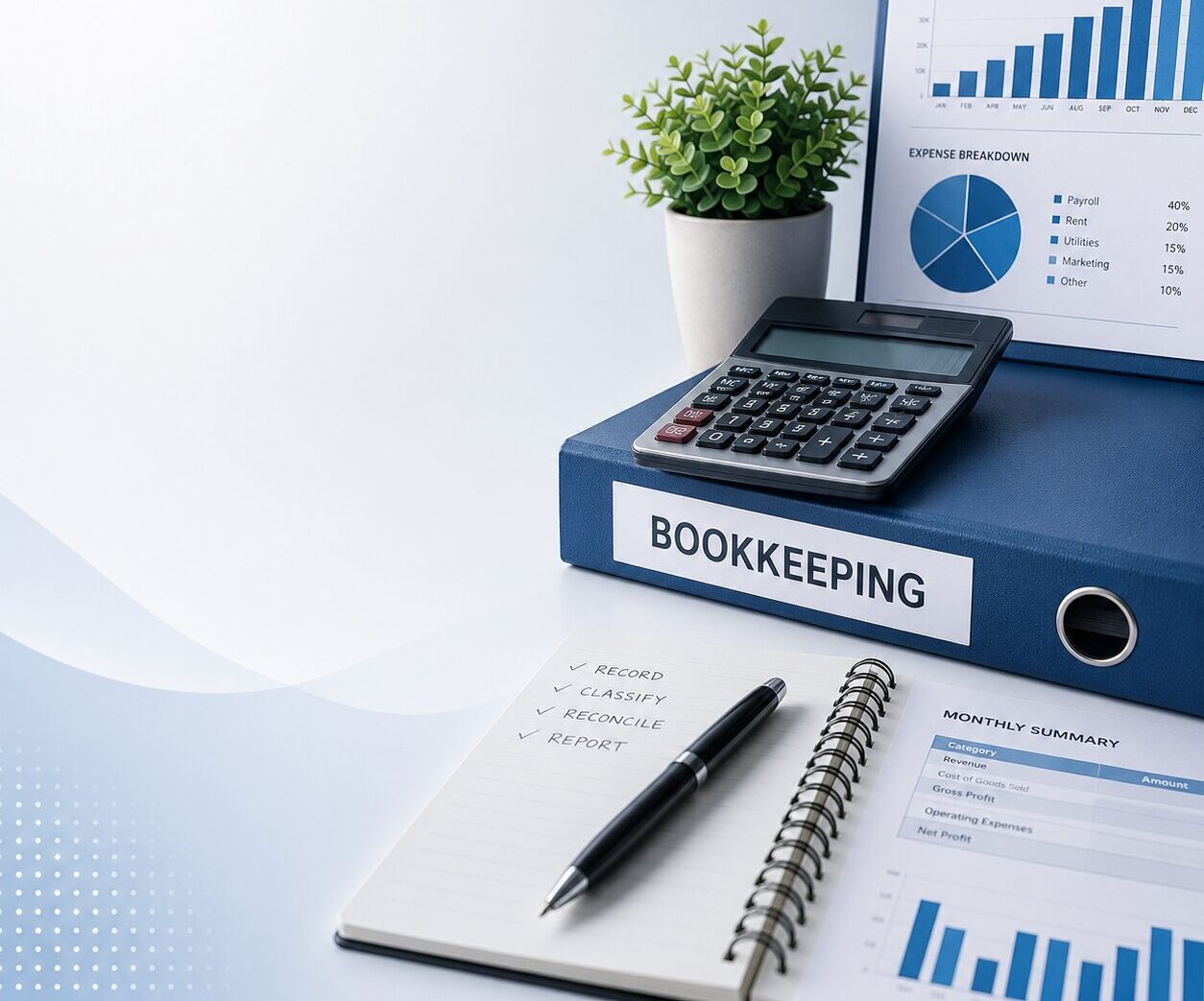
Bookkeeping is the ongoing recording of your business’s financial transactions. This includes sales, purchases, expenses and payments. It keeps your accounts accurate and up to date, forming the foundation for your VAT returns, tax filings, and financial reporting.
Here are the three most critical categories of documents our bookkeepers will need from you:
-
-
-
- Banking & Sales Records: Full bank statements and copies of all invoices sent to clients.
- Expense & Purchase Proof: Digital or physical receipts for every business purchase and supplier bill.
- Tax & Payroll Details: HMRC correspondence, VAT records, and staff payslips or pension summaries.
-
-
Why Do you need a bookkeeper?
Good bookkeeping isn’t just about compliance. It gives you a clear, real-time picture of your business’s health, helps you spot problems early, and supports better decision-making as you grow.
Our Bookkeeping Services:
Who We Can Help.
Bookkeeping for different types of UK businesses, with a focus on clients based in Surrey and the London area. Here is how Fynax supports the businesses we work with most.
Sole Traders:
Straightforward bookkeeping to keep your Self-Assessment stress-free.
Small & Medium Businesses (SMEs):
Reliable bookkeeping support as your transactions and team grow.
CIS Contractors:
Bookkeeping tailored to construction industry reporting requirements.
Comprehensive Outsourced Bookkeeping for Surrey & London Businesses in 3 Simple Steps:
Which Bookkeeping Method Is Right for Your Business?
Our specialised bookkeepers mainly focus on double-entry rather than single-entry bookkeeping, but it all comes down, in the end, to the business size and nature of operations. That’s where our accountants will come in to provide the best approach. The table below explains the main differences between the two approaches:
| Aspect | Single Entry | Double Entry |
|---|---|---|
| Principle | Each transaction is recorded once | Each transaction is recorded twice (debit + credit). |
| Complexity | Simple | More Structured. |
| Shows | Income and Expenses Only | Full Picture: assets, liabilities, equity, income, expenses. |
| Error Checking | None Built In | Self-balancing, so errors are easier to catch. |
| Best For | Very small/simple businesses | Limited Companies, VAT-registered businesses. |
Bookkeeping Software we work with
Our expert bookkeepers use approved bookkeeping software, mainly our premium partners Xero and QuickBooks. Depending on your business size and transaction volume, we recommend the most suitable approved software for your needs. Most of our clients prefer that we set it up for them, ensuring it’s configured correctly from the start. If you’d rather manage it yourself, we’ll provide full training to get you up and running.

Making Tax Digital: Is Your Bookkeeping MTD-Ready?
HMRC’s Making Tax Digital (MTD) initiative is pushing businesses away from manual record-keeping and towards digital accounting software. For many, this is now a legal requirement and not just a preference.
Manual bookkeeping — paper ledgers and spreadsheets — is low-cost and familiar, but prone to error, time-consuming to maintain, and offers no real-time insight into your finances. Switching to digital bookkeeping solves all of this, while keeping you ahead of HMRC’s Making Tax Digital requirements.
Bookkeeping FAQ
A bookkeeper handles the day-to-day administrative recording of transactions, bank reconciliations, and payroll. An accountant analyzes that data, provides strategic tax advice, and submits year-end statutory accounts.
Financial experts advise doing bookkeeping weekly or monthly. Leaving transactions to pile up until the end of the tax year leads to errors, missed tax deductions, and stressful deadline scrambles.
The industry standards for MTD-compliant cloud software are Xero, QuickBooks, and Sage. FreeAgent is also highly popular and often free if you bank with NatWest, RBS, or Mettle.
Cash basis records income and expenses when cash physically changes hands. Accrual basis records invoices and bills when they are raised or received, regardless of when payment occurs.
Limited companies must use a dedicated business bank account because the company is a separate legal entity. Sole traders are legally permitted to use personal accounts, but separate business accounts are strongly recommended to avoid confusing cash flow and messing up reporting.
You can claim costs that are wholly and exclusively for the purposes of running your business. Common examples include software subscriptions, office rent, utilities, insurance, marketing, and business travel.