Inheritance Tax in the UK is often viewed as something only very wealthy people should be concerned with; however, with rising property prices and frozen thresholds, an increasing number of individuals are now being drawn into the scope of Inheritance Tax rules. As a result of this, estates which may not have previously been considered high value may now be subject to significant tax liabilities.
Therefore, without an effective inheritance tax plan in place, up to 40% of an estate above the available allowances could be payable to HMRC, which can reduce the amount passed on to loved ones. Despite this, there are many individuals who are unaware of the right steps to take. Our expert accountants have helped many of our clients to effectively plan their inheritance tax so their loved ones are able to benefit from most of what they spent years working for.
This blog will explore the current inheritance tax thresholds in the UK, explain how the system works, and outline practical strategies that Fynax Tax Experts can help you with to reduce inheritance tax and protect your estate.
What is Inheritance Tax?
Inheritance Tax in the UK is a tax applied to the estate of a person who has passed away. An estate can include property, savings, investments, and personal possessions. In some cases, gifts that are made during a person’s lifetime may also be taken into account when calculating the total value of the estate for inheritance tax purposes.
In the UK, the standard rate of inheritance tax is 40%; however, this rate only applies to the portion of the estate that exceeds the available inheritance tax thresholds. The rules regarding inheritance tax are set and administered by HMRC and can become quite complex, it is important to understand how inheritance tax planning works and key tax reliefs.
Current UK Inheritance Tax Thresholds
In order to achieve effective inheritance tax planning, you must understand the available allowances and how they can apply to your estate.
Each individual is entitled to a nil rate band of £325,000. This is the amount which can be passed on free from inheritance tax. Additionally, for married couples and civil partners, any of the unused nil rate band can be transferred, which therefore increases the threshold to up to £650,000.
Furthermore, the residence nil rate band provides individuals with an extra allowance of £175,000, if the main residence is passed on to the direct descendants. With all of these allowances combined, it can allow up to £500,000 per individual or £1 million per couple to be passed on without incurring inheritance tax.
However, these allowances are subject to tapering if the estate is valued over £2 million, which means the available relief will be significantly reduced.
Why are more estates being taxed?
Recently, there has been a growing number of families that have become subject to inheritance tax, even though there have not been significant changes to tax legislation. One of the main reasons for this is the increase in property prices, especially in high-demand areas such as London.
Alongside this, the inheritance tax thresholds have remained frozen, which means that more estates are slowly exceeding the available allowances, as the values of the assets increase. Furthermore, there has been an increase in savings, investments, and pension wealth, which has also contributed to overall higher estate values.
As a result of this, individuals who may not be actively considering inheritance tax planning are increasingly finding themselves paying higher taxes, which reinforces the importance of informed and early planning. At Fynax, our tax experts have over 20 years of experience working with clients across all estate sizes to ensure that no one pays more than they need to.
How is inheritance tax calculated?
It is important to understand exactly how inheritance tax is calculated and it is even more important when understanding how to reduce your inheritance tax liabilities.
Firstly, the total value of the estate is calculated. This includes property, savings, investments and personal belongings. Any outstanding debts such as mortgages or loans are then deducted from this to determine the net estate value.
Next, the relevant inheritance tax allowances, such as nil rate band and any applicable residence nil rate band are applied and deducted. Then, the remaining amount is what is considered the taxable portion of the estate and is subject to inheritance tax at 40%.
For example, if an estate is valued at £900,000 and the total deductible allowances amount to £500,000, the remaining £400,000 would be subject to inheritance tax. This would result in a tax liability of £160,000.
If you are unsure how to calculate your own estate’s potential tax liability, Fynax Tax Experts can carry out a full estate review and provide you with a clear picture of your current position. If you have any questions, don’t hesitate to contact us today.
Practical ways to reduce your IHT.
There are multiple strategies available for individuals who want to reduce their inheritance tax liabilities and protect more of their estate.
The annual gift allowance is one of the simplest ways to reduce inheritance tax. Individuals are able to give away up to £3,000 each tax year without it being included in their estate for inheritance tax purposes. Small gifts and certain wedding gifts can also qualify for exemption from inheritance tax.
Large gifts may fall under the 7-year rule, which means they can become fully tax-exempt if the individual survives for 7 years after making the gift. If the individual passes within this period, a taper relief may reduce the amount of tax that is payable on the gift.
Trusts are another tool which is commonly used in inheritance tax planning, as they allow individuals to pass on their assets while retaining some control. But due to their complexity, our accountants at Fynax always recommend seeking professional advice before considering this option, and we are well placed to guide you through the process.
Pension planning can also play an important role, as pension funds are often excluded from an estate for inheritance tax purposes. This makes them a very efficient way to transfer wealth, and Fynax Tax Experts can help you to structure your pension in the most tax-efficient way possible.
Additionally, taking out a life insurance policy written in a trust can help provide the funds to cover any potential tax liabilities, which also ensures that beneficiaries are not able to sell any assets.
Lastly, leaving at least 10% of your estate to charity can reduce your overall rate of inheritance tax from 40% to 36%, giving you both a tax advantage and a chance to support charitable causes.
The Cost of Waiting: James vs Sarah
To explain why timing is crucial in inheritance tax planning, consider these 2 individuals who have similar estates but very different approaches.
James Planned Early
His Situation
James has an estate valued at £850,000, comprised of his home, savings, and a small investment portfolio.
The Actions Taken
With guidance from Tax Experts, James begins by gifting £3,000 per year to his children under the annual gift allowance. Over 10 years, this alone removed £30,000 from his taxable estate. He also makes three significant gifts under the 7 year rule, which total £75,000, all of which become fully exempt as James remains in good health. Additionally, a life insurance policy is placed into trust to cover any remaining exposure, and his pension is structured to sit outside the estate.
The Outcome
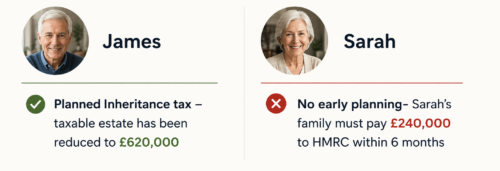
The taxable estate has been reduced to £620,000. After applying both the nil rate band and the residence nil rate band (£500,000), the taxable amount is just £120,000, resulting in an IHT liability of £48,000, which is fully covered by the trust-held life insurance policy.
As a result, his family will inherit the full estate with no tax bill and no need to sell any assets.
Sarah, no early planning
Her Situation
Sarah has a very similar estate to James, valued at £850,000, but assumes her family will not be affected by inheritance tax because she considers her estate not to be large enough. She does not seek professional advice and takes no planning steps.
What Happens Instead
As property values rise over the following decade, Sarah’s estate grows to £1.1 million by the time she passes away. No gifts were ever made, no trust was established, and the pension remained inside the estate. After applying the £500,000 threshold, £600,000 is subject to IHT at 40%, resulting in a tax bill of £240,000
The Outcome
Sarah’s family must pay £240,000 to HMRC within 6 months. With no life insurance policy in place and insufficient liquid savings to cover this, they are forced to sell the family home. A significant portion of the estate Sarah spent her lifetime building is lost to a bill which, with early planning, could have been drastically reduced.
The difference between James and Sarah is not the size of their estate; it is their decision to plan early.
Common mistakes people make:
Despite the number of effective strategies, many individuals make avoidable mistakes that end up increasing their tax liability.
One main misconception individuals have is assuming that all assets will automatically pass on tax-free to their family members. However, in reality, without taking into consideration the inheritance tax thresholds, a substantial portion of the estate may still be subject to tax. Therefore, leaving planning too late can impact the amount you pay. Strategies such as making gifts under the 7 year rule are the most effective when they are implemented early.
If you are unsure where to start, Fynax Tax Experts can help you identify and correct any planning gaps before they become costly.
Why early planning matters?
Taking informed action in advance helps individuals to make full use of their available allowances and gradually reduce the value of their taxable estate over time.
Early planning also provides you with greater flexibility when using more complex strategies such as trusts or pension structuring, which play an important role in reducing inheritance tax liabilities.
Starting early can not only help you reduce your inheritance tax but also ensure that your estate is distributed according to your wishes, giving you both financial efficiency and peace of mind. The accountants and tax experts at Fynax are here to support you at every stage of that journey.
Inheritance tax in the UK can become a large financial burden if it is not carefully managed. However, with a clear understanding of the inheritance tax thresholds and the perfect planning strategies in place, it is very possible to reduce your inheritance tax liabilities and preserve more of your estate for future generations.
As every estate is different, seeking professional advice is important to ensure that any strategy is created appropriately and is aligned with the current legislation. Fynax Tax Experts are experienced in helping individuals and families across a wide range of estate sizes to plan effectively and efficiently. Taking action early can make a large difference both in tax efficiency and long-term security. Get in touch with the team at Fynax today to find out how we can help you.